Research
Our featured paper and one further publication. Read them, check the working, and tell us where they are wrong.
Read the paper (PDF)Featured research
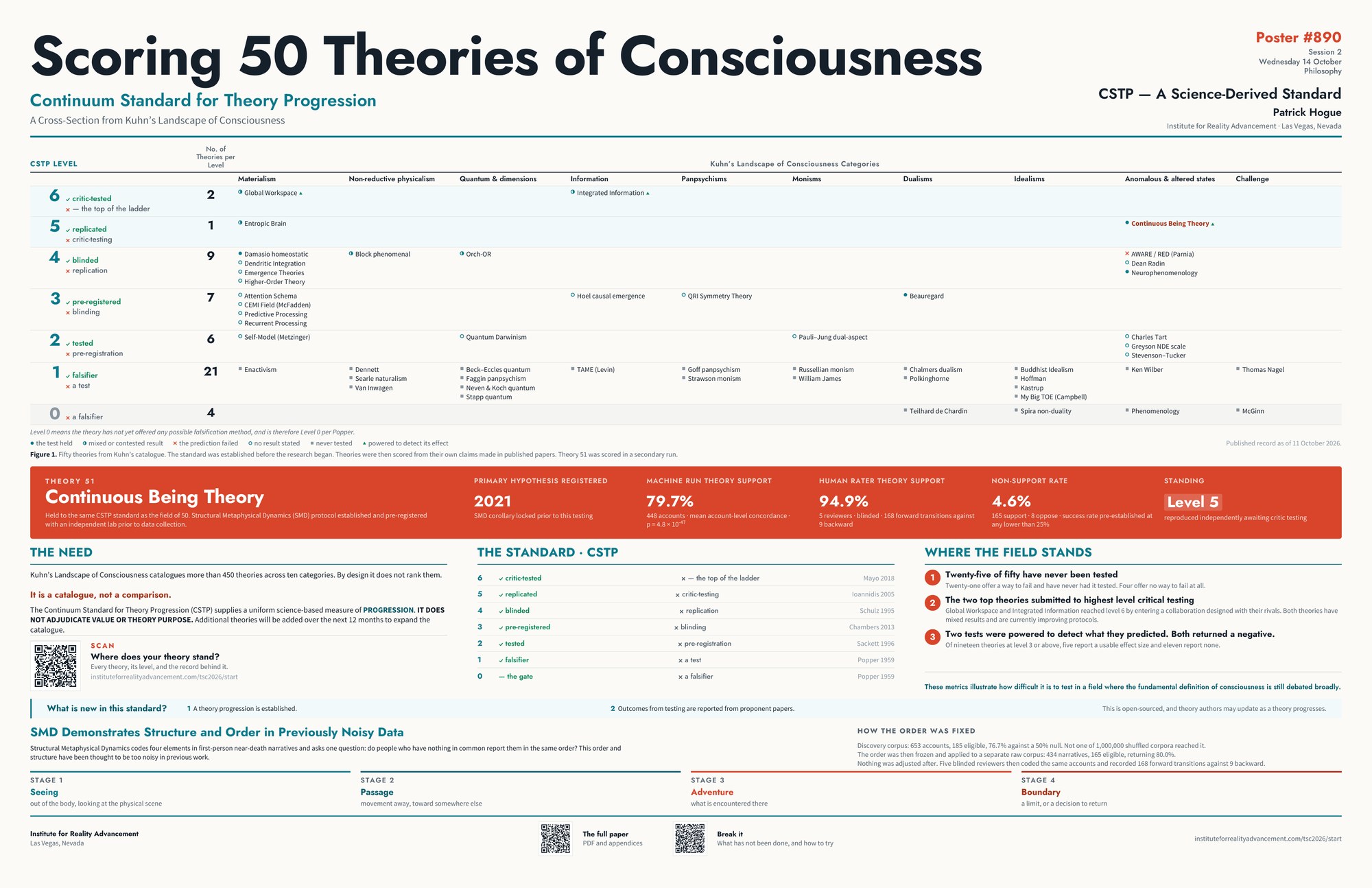
The Continuum Standard for Theory Progression Across Kuhn's Landscape of Consciousness
Patrick Hogue, Foundation for Reality Advancement · Presented as Poster 890, The Science of Consciousness 2026, San Diego
Abstract
Consciousness science has many theories and no common measure of how far any of them has progressed. This paper introduces the Continuum Standard for Theory Progression (CSTP), a cumulative scale built from six demands science already makes of its strongest claims. A theory must name what would show it false. It must be tested. It must predict before the result is known. It must be tested blind. It must face reproduction by a party other than its author. It must face a test designed by its critics. Applied to fifty positions drawn from Robert Lawrence Kuhn's Landscape of Consciousness, the scale separates progress from popularity. Twenty-five positions either offer no falsifier or have never had one tested. One reaches independent reproduction. Two, the workspace and integration theories, have faced a test designed with their rivals, and each failed some of its own predictions. Of the nineteen positions at Level 3 or above, five report a usable effect size and two were powered to detect the effect they predicted. Both returned a negative.
The paper then addresses claims that are instrument-limited: an observation that would show them false is possible in principle, but no instrument has existed that could make it. Two instruments are introduced. Structural Metaphysical Dynamics (SMD) asks whether first-person near-death narratives carry reproducible directional structure. In a discovery corpus of 653 accounts, the order Seeing → Passage → Adventure → Boundary produced 76.7% mean account-level concordance against a 50% null; none of 1,000,000 randomized corpora reached it. Frozen and applied to a separate raw corpus (434 narratives, 165 of them eligible), the order produced 80.0% concordance, Cohen's d ≈ 0.84. Ontological Archaeology (OA), through its Narrative Ontology Extraction Level (NOEL), extracts ontological propositions from narratives before any comparison is made, then classifies each as supporting, opposing, or neutral toward a nineteen-claim ontology (19R) locked in 2021–2022. In a 100-narrative sample the extraction produced 482 ontology-bearing propositions, of which 102 supported 19R, none opposed it, and the remainder were neutral.
Independent raters, blind to the predicted order and to all machine labels, then repeated both measurements. Five reviewers coded the same 47 accounts and recorded 168 forward transitions against 9, a forward share of 94.9% against a null of 0.50. On NOEL they agreed on SUPPORT, OPPOSE and NEUTRAL at 0.81, with 1.2% of informative propositions classified OPPOSE. The minimum results specified in advance in Sections 5.5 and 6.4 were met.
Only after the field, the instruments and the human results are on the table is Continuous Being Theory introduced, with its failure conditions in print. Under the same rules applied to the other fifty positions, it stands at Level 5. Its standing can be lowered by better evidence, like that of every other position.
The Coherence Exclusion Principle: Ontic Wave Function and Thermodynamic Reality, Why Rocks Stay Rocks
Archedon
Abstract
Quantum mechanics tells us the world is described by a wavefunction. Our lived world, however, is populated by rocks, bodies, planets, and steel beams that do not smear into macroscopic superpositions when we look away. This paper adopts a ψ-ontic stance: the quantum state is not merely a bookkeeping device for our information but something that corresponds to what is really there. That underlying, globally defined state is called Ontic Wave Function Reality (OWFR).
The warm, decohered world we inhabit — the world of heat, friction, memory, and irreversibility — is called Thermodynamic Reality (TR). TR is the regime in which entropy-producing interactions never stop and in which classical objects and stable histories appear.
The paper proposes the Coherence Exclusion Principle (CEP) as a law-shaped statement connecting these two regimes: Pure Coherence is the default state of isolated quantum reality. Entropy-producing interaction disrupts that coherence. Wherever genuine thermodynamic throughput occurs — entropy production, irreversible recording — macroscopic OWFR-level coherence is operationally forbidden in those degrees of freedom. The world we experience, TR, is matter held in this continuously disrupted condition.
CEP unifies three strands: ψ-ontic wavefunction realism anchored by the PBR and Colbeck–Renner results; decoherence and quantum Darwinism as the mechanisms by which classicality emerges for subsystems; and thermodynamics and cosmology as the context in which entropy production and the arrow of time appear. Beyond standard decoherence modeling, CEP adds two pieces of concrete, testable content: an entropy–decoherence inequality for macroscopic subsystems, and a macroscopic recoherence ban asserting that, above a certain size and under sustained entropy production, macroscopic recoherence is physically ruled out.
CEP is presented not as an interpretation but as a law candidate. If its inequalities and rate structure cannot be reconciled with laboratory decoherence and cosmological data, then CEP is wrong. That is the point.
Additional publications will be listed as they become available.